When did GPT-6.2 launch, and who can use it in ChatGPT and Codex?
OpenAI released GPT-6.2 Astra and GPT-6.2 Sol on November 17, 2026. I’d start with Sol for routine code changes, data summaries and jobs with a clear acceptance test. I’d bring in Astra when sources contradict each other, a complex workbook is going to a client, or a patch keeps coming back from review. At four times Sol’s standard token rates, Astra earns its keep when you can name the revision it saves. OpenAI release announcement
At launch, Plus, Pro, Enterprise and Edu users have access to both models in ChatGPT Work and Codex. API developers can select gpt-6.2-sol or gpt-6.2-astra. For a comparison in Codex, record the selected model, reasoning effort and available tools. Giving one session the workbook and the other a screenshot changes the problem before either model gets to work. OpenAI availability details · API changelog
GPT-6.2 API pricing and the cost of one job
These are launch prices in US dollars per million tokens at the Standard short-context rate. The cached-input column applies to cache hits. Billable tools and cache writes have their own charges. OpenAI API pricing
| Model | Uncached input | Cached input | Billed output |
|---|---|---|---|
| GPT-6.2 Sol | $2.00 | $0.10 | $10.00 |
| GPT-6.2 Astra | $8.00 | $0.40 | $40.00 |
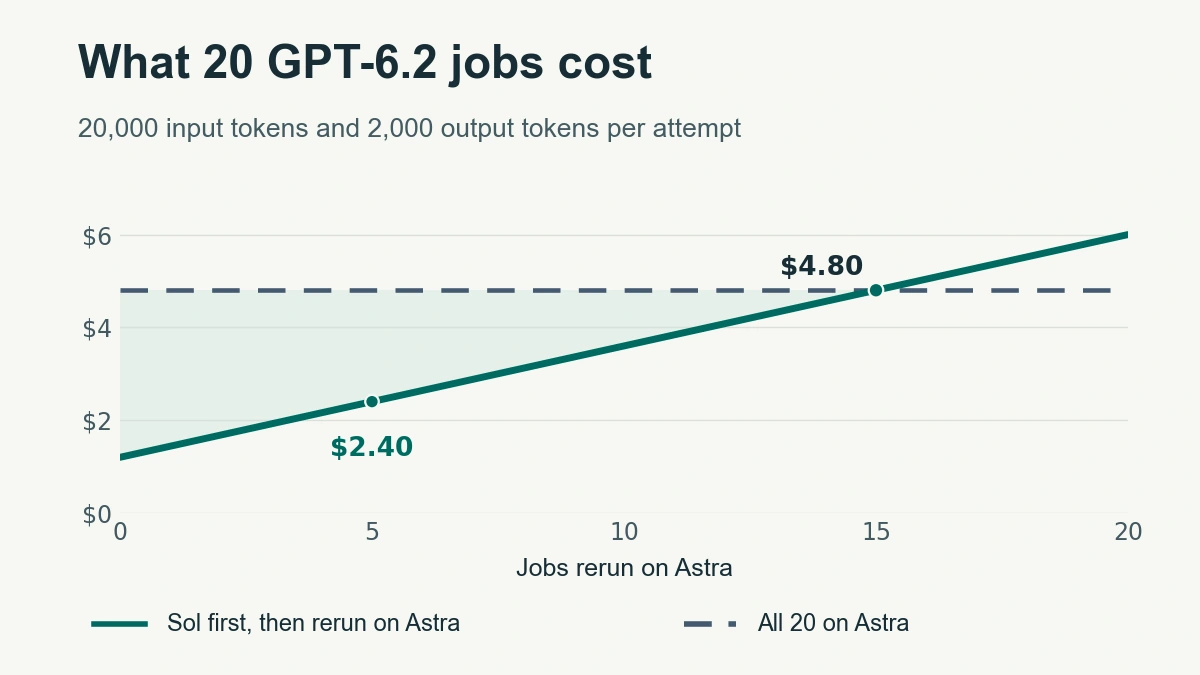
Suppose a job reads 20,000 uncached input tokens and uses 2,000 billed output tokens. Sol costs $0.06 and Astra $0.24. For 20 jobs of that size, sending all of them to Astra costs $4.80. Running all 20 on Sol and five of them again on Astra costs $2.40, assuming the same token counts per attempt. At 15 reruns, the two strategies both cost $4.80. The practical question is whether you can spot the five that need a second pass. Replace these illustrative counts with reported usage when budgeting for your team.
GPT-6.2 Sol keeps GPT-6.1 Sol’s standard rates. Compared with the original GPT-6 Astra, GPT-6.2 Astra cuts the uncached input and output rates by 20%. A million cached input tokens drops from $1.00 to $0.40. A team already running Astra can use the three line items on its last bill to estimate what the rate change alone would save. OpenAI’s comparison with the previous generation
GPT-6.2 Sol vs GPT-6.1 Sol on knowledge work and coding benchmarks
On OpenAI’s GDPval v2 evaluation of long-running professional tasks, GPT-6.2 Sol gains 5.3 percentage points over GPT-6.1 Sol. GPT-6.2 Astra gains 6.2 points over the previous Astra while using 22% fewer output tokens. The tasks include finance and design work. For a team producing quarterly decks, a practical test is to give the model the source workbook and the usual template. Change one figure and check whether it follows that correction through the chart, slide title and commentary. OpenAI’s GDPval v2 results and workbook examples
For coding, Cognition’s FrontierCode 2.0 asks open-source maintainers what it would take to merge a change. It publishes a weighted implementation score and average spend per run at public API rates. Here are four rows from the November 18 leaderboard. Cognition’s results and grading method
| Model and reasoning effort | Runtime | Weighted score | Mean cost per run |
|---|---|---|---|
| GPT-6.1 Sol · max | Codex | 39.6% | $1.03 |
| GPT-6.2 Sol · max | Codex | 43.8% | $1.29 |
| GPT-6.2 Astra · max | Codex | 44.2% | $5.97 |
| Claude Fable 5.2 · xhigh | Claude Code | 50.2% | $17.73 |
The two Sol generations have the same token rates, yet the mean cost on this suite rose from $1.03 to $1.29. Moving from 6.2 Sol to 6.2 Astra then added 0.4 percentage points and $4.68 per run. That makes Sol a reasonable first trial for patches with a regression test and a diff someone can review. If a failure is expensive, check whether a stronger model preserves the old behavior, writes a test that catches the failure and saves the maintainer another revision.
GPT-6.2 Astra vs Claude Fable 5.2 at the same base token price
Both vendors list $8 for uncached input and $40 for output per million tokens at their standard base rates. Yet OpenAI reports that on Agents’ Last Exam, a benchmark of long professional workflows, Astra scored 5.5 points higher than Fable 5.2 at about 5% of the cost. The two figures price different things. A rate buys a given number of tokens. Finishing a task can take a different number of turns, tool calls and reasoning tokens on each model. Anthropic model specifications · OpenAI’s launch comparison
One footnote matters before you budget from that headline. OpenAI says the leaderboard results for Fable 5.2 exclude nine tasks that used a fallback model. In a team trial, keep the failed runs and fallbacks in your records and count the reviewer’s time per accepted result. A polished report that omits a worksheet and takes half an hour to repair will then show up at its actual cost to the team. Agents’ Last Exam leaderboard · How to measure the cost of an AI workflow
When should Astra take a second look? A test with 630 sales records
We retrieved the two original Teacher’s Tech workbooks used in an earlier analysis, matched their file hashes and recalculated the results row by row. One contains 630 sales and the other 200 customers. The following scoresheet lets you try either model with the original files and the same short request. The calculations come from the workbooks. The model benchmarks above come from their publishers. Teacher’s Tech source files · Onevium’s analysis and reproducible scripts
Our manager wants a repeat-customer rate and a win-back list by sales channel. Give her a short answer she can use in a meeting. Show how you arrived at it and identify any information you still need.
| What the reviewer checks | What the source supports |
|---|---|
| How many customers have the repeat label? | 56 of 200, or 28%, have the supplied label. |
| How many have placed at least two orders? | 157 of 200, or 78.5%. The two definitions disagree on 101 records. |
| Can a sale be attributed to an individual customer? | Sales has no customer ID. Joining on channel alone expands 630 sales into 32,670 rows and inflates total revenue from 74,428 to 4,353,295. |
A first pass is ready for the manager if it explains both rates, flags the missing key and asks which definition should guide outreach. An answer that quotes 78.5% and names individual customers deserves a second review. Even Astra needs a customer key and an agreed definition to turn those records into a contact list. Keep each model’s answer next to its usage and your edits. That record tells you whether to escalate the next job of this kind.
GPT-6.2 context window and tool calling in the API
Both models list a 1,050,000-token context window, a maximum of 922,000 input tokens and a maximum of 128,000 output tokens. Once an input exceeds 272,000 tokens, input and cache rates double and output costs 1.5 times the short-context rate for the entire request. With 300,000 uncached input tokens and 2,000 billed output tokens, Standard long-context pricing comes to $1.23 on Sol and $4.92 on Astra. Sol model specifications · Astra model specifications
Both models accept the Responses API and Chat Completions. Tool calling requires the Responses API. When migrating an integration, send a short text request and then make one read-only tool call. In a custom Onevium connection, check the upstream model ID and connection type as well. Once those checks pass, run the original work sample through the same connection. OpenAI API changelog · Onevium custom connection guide